W180 is the larger premium grade (140–180 kernels per pound); W320 is smaller (300–320 per pound) and cheaper. They taste identical — the difference is kernel size, price and presentation. Choose W180 for gifting and whole-cashew dishes; W320 for everyday cooking and snacking.
If you've ever shopped for cashews online, you've probably seen labels like W180, W240, W320, and W450. These aren't random codes — they're international grading standards set by the Association of Food Industries (AFI) and the Cashew Export Promotion Council of India (CEPC) that tell you exactly what you're getting.[1][2]
In this guide, we break down the two most popular grades — W180 (King Size) and W320 (Regular) — with data from peer-reviewed research and government databases, so you can make an informed choice.

What Do Cashew Grades Mean?
Cashew grades follow a standardised system governed by AFI specifications and India's Export (Quality Control and Inspection) Act, 1963.[1][2] The number refers to how many whole cashew kernels fit in one pound (454 grams). The lower the number, the bigger the cashew.
The Government of India prescribes 33 different grades of cashew kernels, though only 26 are commercially traded.[2] W180 and W320 are the two grades consumers encounter most often — one at the premium end, the other as the everyday standard.
W180 vs W320: Side by Side
| W180 — King | W320 — Standard | |
|---|---|---|
| Kernels per pound | 140–180 | 300–320 |
| Size & look | Largest, full, uniform | Medium, everyday |
| Nutrition (per gram) | Identical | Identical |
| Best for | Gifting, serving whole, festive bowls | Cooking, blending, daily snacking |
| Price | Premium (20–30% higher) | Value |
Why Are W180 Cashews So Rare?
Only the top 1% of the global cashew harvest qualifies for the W180 grade.[3] The cashew tree (Anacardium occidentale) produces fruits of varying sizes, and only a small fraction of kernels meet the W180 size threshold.
After harvesting, cashews go through shelling, peeling, and grading. At each step, kernels can break — and a broken W180 gets downgraded. The ones that survive the entire process intact are sorted by hand, one by one. W180 kernels typically command prices 20–30% higher than W320, a premium that reflects both rarity and the higher skill required during processing.[3]
India, Vietnam, and parts of West Africa are the primary sources. Vietnam alone supplies over 60% of the world's cashew kernels.[3] Indian W180 cashews — particularly from Goa and Kerala — are valued for their natural sweetness and creamy colour.
Nutritional Comparison
Both grades come from the same species (Anacardium occidentale), so the nutritional profile per gram is virtually identical regardless of kernel size. A 2015 study in Food Science & Nutrition analysed cashew samples from six countries (India, Brazil, Ivory Coast, Kenya, Mozambique, Vietnam) and found minimal nutritional variation across origins.[4]
The NIH Office of Dietary Supplements recommends 310–420 mg of magnesium daily for adults, and notes that many people consume less than recommended amounts.[6] The ICMR-NIN 2020 guidelines for Indian adults set the RDA even higher — 440 mg/day for men and 370 mg/day for women.[7] A 100 g serving of cashews provides 57–67% of the ICMR daily value for magnesium, making them one of the richest nut sources of this mineral.
The grade tells you the size of the cashew — not the soul of it. Freshness and origin still decide taste.
The Science: Heart Health and Blood Sugar
Cashews aren't just tasty — there's growing clinical evidence for their health benefits.
Cholesterol reduction
A 2017 randomised, crossover, controlled-feeding trial published in The American Journal of Clinical Nutrition studied 51 adults with elevated LDL cholesterol. Those who consumed 28–64 g of cashews daily for 28 days showed:[8]
- Total cholesterol: reduced by 3.9% (vs. 0.8% increase in control group)
- LDL ("bad") cholesterol: decreased by 4.8% (vs. 1.2% increase)
- Non-HDL cholesterol: lowered by 5.3% (vs. 1.7% increase)
Blood pressure and HDL in diabetic patients
A 2018 randomised controlled trial published in The Journal of Nutrition — conducted specifically on 300 Asian Indians with type 2 diabetes — found that consuming 30 g of cashews daily for 12 weeks:[9]
- Reduced systolic blood pressure by 4.9 mmHg (vs. 1.7 mmHg in control)
- Increased HDL ("good") cholesterol by 1.7 mg/dL (vs. 0.1 mg/dL in control)
- Had no negative effects on body weight, blood sugar, or other lipid markers
Why oleic acid matters
Cashew fat is approximately 60.7% oleic acid — a monounsaturated fatty acid (MUFA) also found in olive oil.[4][10] Diets rich in oleic acid, such as the Mediterranean diet, are associated with reduced cardiovascular disease risk. Research published in Food Science & Nutrition confirmed that cashew oil contains around 82% unsaturated fatty acids overall, making it comparable to olive oil in fat quality.[4][10]
Taste and Texture: Does Size Actually Matter?

Yes — and it's not just perception. Larger cashews have a higher ratio of interior (creamy part) to exterior (drier skin layer). This means:
- W180 cashews taste more buttery because you're getting more of the rich, creamy centre in each bite
- The crunch is more satisfying — there's more surface area for roasting to create that golden exterior
- The sweetness is more pronounced — natural sugars concentrate differently in larger kernels
If you've only ever had W320 cashews (which is what most stores sell), trying a W180 for the first time is genuinely surprising. The flavour difference is similar to the jump from regular almonds to Mamra almonds — you wonder why you settled for less.
So — Which Grade Should You Buy?
Choose W180 if…
- You're buying cashews as a gift — the size makes an immediate impression
- You want the best snacking experience — each cashew is a full bite
- You're garnishing biryani, kheer or halwa — larger cashews look and taste better
- You're serving at a dinner party or celebration
Choose W320 if…
- You're cooking or baking — the cashews get chopped or ground anyway
- You need them for cashew cream, butter or gravies
- You want good nutrition at a lower price point
- You're buying in bulk for daily consumption
The honest truth: if you're going to eat them whole — as a snack, with chai, or as a garnish — W180 is worth every extra rupee. If you're going to blend or chop them, W320 gives you the same nutrition for less.
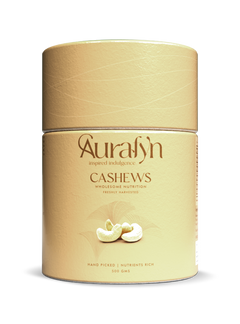
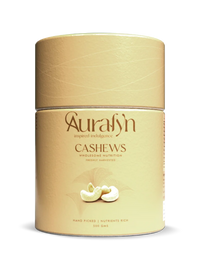
Aurafyn W180 King Size Cashews
Whole, creamy and hand-graded to the king standard — the grade premium gifting is built on. Never polished, never fried.
How to Spot a Genuine W180
- Count test: weigh out one pound (454 g) — you should get 140–180 whole kernels. If you count 220+, they're likely W240 or W320 sold as W180.[1]
- Size check: each kernel should be roughly the size of your thumb's top joint (~2.5 cm long).
- Colour: genuine premium W180s are ivory to pale cream. Very white cashews may be chemically bleached.
- Wholeness: a premium W180 pack should have less than 2% broken pieces.
- FSSAI licence: always buy from sellers with a valid FSSAI number, ensuring the cashews meet food-safety standards under India's Food Safety and Standards Act, 2006.[11]
Storage Tips for Maximum Freshness
Cashews are high in unsaturated fats (82% of total fat[10]), which means they can go rancid if stored improperly — regardless of grade.
- Sealed container: transfer to an airtight glass or steel container immediately after opening
- Cool, dark place: a cabinet away from the stove; avoid direct sunlight
- Refrigerate for long storage: 6+ months in the fridge, up to a year in the freezer
- Smell test: fresh cashews smell mildly sweet — sharp or paint-like means rancid, discard them
- Keep dry: never use a wet spoon; moisture accelerates spoilage
Why Aurafyn Chooses W180
At Aurafyn, we only stock W180 King Size cashews. Here's why:
- If you're buying premium dry fruits, you should get the best grade available — not a compromise
- Our cashews are hand-sorted so every kernel in your pack meets the W180 standard
- We source directly, cutting out middlemen who often mix grades to improve margins
- Every pack carries our FSSAI licence number (22725925002232) for full traceability[11]
We'd rather sell fewer cashews at the right grade than more at a misleading one. That's the Aurafyn standard — for cashews, Mamra almonds, Kashmir walnuts, and everything else we offer.
The Bottom Line
Cashew grades exist for a reason. W180 and W320 are both good cashews — but they serve different purposes. W320 is the practical, everyday choice. W180 is the premium choice that also happens to taste significantly better, backed by the same excellent nutritional profile that clinical research links to lower cholesterol and better heart health.[8][9]
If you've never tried a genuine W180 cashew, we'd encourage you to — the difference is something you have to experience, not just read about.
Frequently asked questions
What do cashew grades like W180 and W320 mean?
The number is how many whole kernels fit in one pound, so a lower number means a bigger cashew. W180 runs 140 to 180 per pound; W320 runs 300 to 320. The grades follow AFI specifications and India's Export (Quality Control and Inspection) Act, 1963. The Government of India prescribes 33 grades in all, of which 26 are commercially traded.
Is W180 more nutritious than W320?
No. Both are the same species, Anacardium occidentale, so the profile per gram is effectively identical. A 2015 study in Food Science and Nutrition analysed cashews from six countries and found minimal nutritional variation across origins. You are paying for kernel size and presentation, not for nutrition.
Why are W180 cashews so expensive?
Only about the top 1% of the global harvest qualifies for the grade. Kernels break during shelling, peeling and grading, and a broken W180 is downgraded. The ones that survive intact are sorted by hand, one at a time. W180 typically commands 20 to 30% more than W320.
Which cashew grade should I buy?
W180 for gifting, serving whole and festive bowls, where size is the point. W320 for cooking, blending and everyday snacking, where it is not. The taste is the same either way.
How much magnesium is in cashews?
A 100 g serving provides 57 to 67% of the ICMR daily value, which makes cashews one of the richest nut sources of the mineral. ICMR-NIN's 2020 guidelines set the Indian adult RDA at 440 mg a day for men and 370 mg for women, and the NIH Office of Dietary Supplements notes many people consume less than recommended.
Do cashews affect cholesterol?
A 2017 randomised controlled-feeding trial in the American Journal of Clinical Nutrition followed 51 adults with elevated LDL who ate 28 to 64 g of cashews daily for 28 days. Total cholesterol fell 3.9%, LDL 4.8% and non-HDL 5.3%, against small rises in the control group. That is research, not medical advice; speak to your doctor about your own diet.
Where do the best cashews come from?
Vietnam supplies over 60% of the world's cashew kernels, with India and parts of West Africa making up much of the rest. Indian W180 from Goa and Kerala is valued for its natural sweetness and creamy colour.
How can I tell a genuine W180?
Count them. A pound should hold 140 to 180 whole kernels; noticeably more and it is a smaller grade being sold as W180. Look for uniform size and whole, unbroken kernels, since grade-mixing is the common shortcut.
This guide cites peer-reviewed clinical trials, ICMR-NIN dietary guidelines and the NIH Office of Dietary Supplements. It is general nutrition information, not personal medical advice — please consult your doctor for your individual needs.
References & Further Reading
- Specifications for Cashew KernelsAssociation of Food Industries (AFI)
- Cashew Kernels — Grades & Specifications (Export Quality Control and Inspection Act, 1963)Cashew Export Promotion Council of India (CEPC)
- W180 Cashew Grade — Market DataCashew Nuts Vietnam / East Africa Foods Supply
- Rico R, Bulló M, Salas-Salvadó J. Nutritional composition of raw fresh cashew kernels from different originFood Science & Nutrition, 2015; 4(2):329–338
- Nuts, cashew nuts, raw (FDC ID 170162)USDA FoodData Central
- Magnesium — Health Professional Fact SheetNIH Office of Dietary Supplements
- Nutrient Requirements for Indians (RDA & EAR), 2020ICMR — National Institute of Nutrition
- Mah E, et al. Cashew consumption reduces total and LDL cholesterol: a randomized, crossover, controlled-feeding trialAmerican Journal of Clinical Nutrition, 2017; 105(5):1070–1078
- Mohan V, et al. Cashew nut consumption increases HDL cholesterol and reduces systolic blood pressure in Asian Indians with type 2 diabetes: a 12-week RCTThe Journal of Nutrition, 2018; 148(1):63–69
- Rico R, et al. Cashew fatty-acid profile — oleic acid 60.7%, ~82% unsaturatedFood Science & Nutrition, 2015
- Food Safety and Standards Act, 2006Food Safety and Standards Authority of India (FSSAI)
Aurafyn Journal. “W180 vs W320 Cashews — Which Grade Should You Buy?.” Updated 18 Oct 2026. aurafyn.com/blogs/journal/w180-vs-w320-cashews-which-grade-should-you-buy