Both are the same species (~65% fat), so the oil content is essentially identical. Kashmir walnuts are a native, fresh-pressed variety with a richer, earthier flavour and softer texture — best for raw eating and traditional recipes. California (Chandler) walnuts are larger, milder, crunchier and cheaper — better for baking. Kashmir costs roughly 2× more.
Walk into any Indian grocery store and you'll find two kinds of walnuts (akhrot): Kashmir and California. Both look similar, both are marketed as "premium" — but the difference in variety, freshness, taste and price is significant, and most buyers don't know what they're actually comparing.
This guide breaks down both varieties using USDA FoodData Central, peer-reviewed trials and direct sourcing information, so you can decide which is right for your kitchen.

The Story Behind Each Variety
Kashmir Walnuts (Juglans regia — native variety)
Kashmir produces over 90% of India's walnut output, grown across the valleys of Baramulla, Shopian, Kupwara and Anantnag.[1] These walnuts are cultivated using traditional, organic, low-input methods — many trees are decades old, some over a hundred years. The cold winters, warm summers and high altitude produce walnuts with thinner shells and a richer, more pronounced flavour. Three native varieties dominate:
- Wonth — the most common; medium-sized, light-coloured kernels
- Kagazi — paper-shell, easy to crack, prized for gifting
- Burzul — large kernel, harder shell, premium grade
Note: Kashmir walnuts have a pending GI (Geographical Indication) application as of 2026. "Kashmir Walnut Wood Carving" (the craft) received GI status in 2012 — that's separate from the walnut itself.[2]
California Walnuts (Juglans regia — "Chandler" variety)
California produces over 99% of US commercial walnuts and about 75% of the world's traded walnuts.[3] The dominant variety is Chandler — a modern cultivar bred in the 1970s at UC Davis.[4] It was selected for:
- Light-coloured kernels (appearance)
- Large, uniform size
- Thin, easy-to-crack shells
- Long shelf life and high yield per tree
Chandler walnuts are grown in highly-mechanised orchards, harvested by tree-shakers and processed at scale — consistent, beautiful walnuts that travel well and last longer on shelves.
Quick Comparison
| Feature | Kashmir Walnuts | California Walnuts |
|---|---|---|
| Origin | Kashmir valley, India | California, USA (Chandler) |
| Farming | Traditional, organic, low-input | Modern, mechanised, commercial |
| Oil character | Rich, fresh-pressed | Milder, commercial |
| Kernel size | Medium, variable | Large, uniform |
| Kernel colour | Light brown to ivory | Light amber, uniform |
| Taste | Rich, earthy, buttery finish | Mild, mellow, less intense |
| Shelf life | Shorter (fresh, minimally processed) | Longer (commercial stock) |
| Price / kg (India) | ₹1,400–2,800 | ₹600–1,200 |
Why Kashmir Walnuts Taste Different
Both varieties are about 65% fat,[5] so the real difference isn't how much oil they carry — it's the variety, the freshness and the character of that oil. Kashmir walnuts are a native landrace grown at altitude and pressed fresh; California's Chandler is a modern cultivar bred for uniformity and long shelf life. That is what you taste.
What that means for you
- Richer flavour — the native variety, grown at altitude and pressed fresh, carries a pronounced earthy, buttery note
- Plant omega-3 — walnut fat is mostly polyunsaturated, including alpha-linolenic acid (ALA), the plant-based omega-3
- Great for cold-pressed oil — fresh Kashmir kernels press beautifully
- Naturally satiating — walnuts are fat-dense and filling per serving
The trade-off
- Shorter shelf life — fresh, minimally-processed kernels go rancid faster than long-shelf commercial stock
- Softer texture — Kashmir walnuts are less crunchy than California
- More expensive — lower yield + traditional farming = 2–3× the price
Same species, two philosophies — one shaped by Kashmiri valleys over centuries, the other bred to ship and last.
Nutritional Comparison (per 100 g, raw)
Both are the same species (Juglans regia), so the nutrition is nearly identical — the figures below are very close across the board.
| Nutrient | Kashmir (est.) | California |
|---|---|---|
| Calories | ~680 kcal | 654 kcal |
| Protein | 14.2 g | 15.2 g |
| Total fat | 63 g | 65.2 g |
| Omega-3 (ALA) | ~10 g | 9.1 g |
| Fibre | 6.7 g | 6.7 g |
| Copper | 1.6 mg (178% DV) | 1.6 mg (178% DV) |
| Manganese | 3.4 mg (148% DV) | 3.4 mg (148% DV) |
Both are nutrient-dense and very close.[5] Either way, a 30 g daily serving of walnuts is one of the richest plant sources of ALA omega-3 you can eat — see how many nuts to eat per day.
Why Walnut Omega-3 Matters
Walnuts are the only nut with significant alpha-linolenic acid (ALA), the plant-based omega-3.[6] A 30 g serving provides ~2.5 g of ALA — exceeding the US Adequate Intake of 1.6 g/day for men and 1.1 g/day for women.[7]
The science on walnut consumption
- Cardiovascular (multiple RCTs): walnut-enriched diets can lower total and LDL cholesterol, raise HDL, and reduce blood pressure, inflammation and plaque formation.[8]
- Cognition in adolescents: a 2023 multi-school RCT in eClinicalMedicine (771 teens, 12 Barcelona schools) found that consistent 30 g/day walnut consumers improved in sustained attention, fluid intelligence, and reduced ADHD symptoms.[9]
- Cognition in older adults: the WAHA study (708 adults, 63–79, 2 years) showed no overall cognitive benefit but post-hoc evidence that walnuts "might delay cognitive decline in subgroups at higher risk."[10]
Taste & Texture: The Real Sensory Difference

Kashmir walnuts
- Taste: rich, earthy, slightly buttery, pronounced walnut flavour
- Texture: soft, tender, melts in the mouth
- Best for: eating raw, kheer and halwa, walnut chutney, cold-pressed oil
California walnuts
- Taste: mild, slightly sweet, almost neutral
- Texture: crunchier, firmer bite
- Best for: baking, granola, salads, industrial food use
How to Identify Real Kashmir Walnuts
- Natural variation: genuine Kashmir walnuts are NOT perfectly uniform — small batch-to-batch variation is normal. Perfect uniformity suggests industrial processing.
- Oil bleed: break a Kashmir walnut and you'll often see a slight oil sheen on the kernel. California walnuts look drier.
- Taste: Kashmir walnuts have a distinct earthy richness; California walnuts are noticeably milder.
- Transparency: trusted sellers disclose the Kashmir district (Baramulla, Shopian, Kupwara, Anantnag) and the variety (Wonth, Kagazi, Burzul).
- FSSAI licence: always buy from FSSAI-licensed sellers.
So — Which Should You Buy?
Choose Kashmir if…
- You eat walnuts raw or in traditional Indian recipes
- You want maximum flavour and omega-3 richness
- You value origin, traceability and supporting Indian farmers
- You're buying for gifting
Choose California if…
- You mainly bake — cookies, brownies, granola
- You want a crunchier, milder, neutral walnut
- Budget and long shelf life are priorities
- You're buying in bulk for everyday use
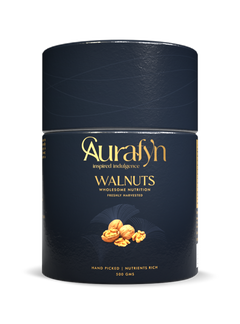
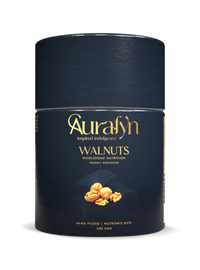
Aurafyn Kashmir Walnuts
Light, plump halves sourced direct from the Kashmir valley — hand-shelled, tube-packed, rich in natural oil.
Storage Tips — Especially for Kashmir Walnuts
Because Kashmir walnuts are fresh and minimally processed, they go rancid faster than long-shelf commercial stock. Proper storage is essential:
- Refrigerate after opening — 2–3 months in the fridge, up to 6 in the freezer
- Airtight container — glass jars or food-grade steel tins are ideal
- Away from heat and light — oxidation accelerates in heat and sunlight
- Buy what you'll use in 3–4 months — Kashmir walnuts are best fresh, not stored a year
- Smell test: fresh walnuts smell sweet and nutty; rancid ones smell sharp or painty — discard them
The Price Gap — Why Kashmir Walnuts Cost 2× More
Kashmir walnuts retail at ₹1,400–2,800/kg; California at ₹600–1,200/kg.[11] Five reasons:
- Lower yield per tree — traditional trees produce less than commercial orchards
- Manual harvesting — no mechanical shakers; labour-intensive hand-picking
- Hand shelling — industrial de-shelling isn't widely used in Kashmir
- Shorter shelf life — faster turnover and higher spoilage risk
- Import pressure — cheaper imported walnuts (Chile, USA, China) make Kashmir a specialty product
Why Aurafyn Chooses Kashmir Walnuts
Aurafyn stocks only Kashmir walnuts — sourced direct from the valley, hand-shelled, tube-packed:
- If you're buying premium walnuts, you should get the variety with meaningful differences — not a mass-produced cultivar
- Ours come directly from trusted growers in the Baramulla and Shopian regions
- Every pack carries our FSSAI licence number (22725925002232) for full traceability[12]
- Your purchase supports Indian farmers, not multinational orchards
- Paper tube packaging maintains freshness despite the naturally shorter shelf life
Frequently Asked Questions
Are Kashmir walnuts really better than California walnuts?
It depends on use. Kashmir walnuts are a fresher, native variety with a more pronounced flavour — better for raw snacking and traditional recipes. California walnuts are crunchier, milder and cheaper — better for baking and bulk use.
Do Kashmir walnuts have a GI tag?
Not yet. The J&K Agriculture Department has submitted a GI application, pending registration as of 2026. "Kashmir Walnut Wood Carving" (the craft) received GI status in 2012 — separate from the walnuts.[2]
How many walnuts should I eat per day?
Most clinical studies use 30 g/day (about 8–10 halves). The US Adequate Intake of ALA omega-3 (1.6 g/day for men) is met by about 20 g of walnuts.[7]
Are walnuts safe during pregnancy?
Yes — walnuts are commonly recommended in pregnancy for their omega-3 (ALA), which supports foetal brain development. As always, consult your doctor for individual advice.
Why are Kashmir walnuts softer than California walnuts?
Freshness and variety. Fresh, native Kashmir kernels are more tender; commercial Chandler walnuts are bred and dried for a firmer, crunchier bite and longer shelf life.
Can I substitute one for the other in recipes?
For baking, yes — interchangeable in cookies, brownies and muffins. For raw eating, garnishing or Indian sweets, Kashmir delivers a richer flavour. For cold-pressed oil, use Kashmir (higher yield).
The Bottom Line
Kashmir and California walnuts are the same species, different philosophies — one shaped by nature and traditional farmers over centuries, the other bred by commercial agriculture to ship, look uniform and last long.
For everyday baking, California walnuts are practical and affordable. For raw snacking, gifting, traditional recipes and maximum omega-3, Kashmir walnuts are worth the premium. If you've only ever eaten California walnuts, try a small pack of Kashmir at least once — the difference is subtle on paper but surprisingly noticeable on the tongue.
References & Further Reading
- India Tree Nuts Annual (walnut production by region)USDA Foreign Agricultural Service — GAIN
- Registered GIs & pending applications (checked 2026)Intellectual Property India
- Industry facts — California walnut production & world shareCalifornia Walnut Commission
- "Chandler" walnut cultivar — characteristics & commercial dominanceCalifornia Walnut Commission
- Nuts, walnuts, english, raw (FDC ID 170187)USDA FoodData Central
- Ros E. Health benefits of nut consumptionNutrients, 2010; 2(7):652–682
- Dietary Reference Intakes — ALA Adequate IntakeInstitute of Medicine (US), National Academies Press
- Walnut-enriched diets & cardiovascular risk markers (RCT evidence)Peer-reviewed clinical trials (PubMed)
- Pinar-Martí A, et al. Walnut consumption & neuropsychological development in adolescents (RCT)eClinicalMedicine, 2023
- Sala-Vila A, et al. 2-year walnut diet & cognitive decline — WAHA studyAmerican Journal of Clinical Nutrition, 2020
- Indian dry-fruit market price data (Apr 2026)Compiled: Aurafyn, Nutraj, Happilo, KisaanSay
- Food Safety and Standards Act, 2006Food Safety and Standards Authority of India (FSSAI)
Aurafyn Journal. “Kashmir Walnuts vs California Walnuts — Which Is Really Better?.” Updated 20 Sep 2026. aurafyn.com/blogs/journal/kashmir-walnuts-vs-california-walnuts-which-is-really-better