Real Mamra almonds are small, curved and irregular, feel faintly oily when pressed hard, taste sweet with no bitterness, and are never priced like California almonds. Five checks settle it, in the order a trader runs them: shape, oil, bite, price and label. No lab, no water bowl.
India is the largest market for California almonds, and about 89% of the almonds it imports come from the United States, almost all of them Californian.[1] There is nothing wrong with a California almond. There is something wrong with selling one as Mamra at several times the price. “Mamra” is one of the most misused names in Indian dry fruit: it appears on bags of ordinary almonds, on blends, and on lookalikes priced to match.
Mamra is a traditional variety grown mainly in Iran, on rain-fed orchards, and prized for its density and natural oils rather than its looks. That is exactly what the five checks look for.
Test 1: Shape, curved and irregular
Hold five kernels in your palm.
- Real Mamra is small to medium and distinctly curved, almost boat-like, with a ridged surface. The kernels are irregular: sizes and curves vary from one to the next, because this is a traditional crop picked and sorted by hand, not a calibrated industrial one.
- Not Mamra: large, flat, smooth kernels of near-identical size. That evenness is the signature of almonds bred and machine-graded for uniformity.

A packet in which every almond looks the same has already answered the question.
Test 2: The press, oil you can feel
Press one kernel hard between thumb and forefinger, or crush it on white paper.
- Real Mamra feels dense and faintly greasy, and a firm press leaves a slight oil mark on the paper. Mamra is noticeably richer in natural oils than common almonds, and that oil is where its flavour lives.
- Not Mamra: feels dry and chalky, snaps cleanly and leaves the paper clean.
One caution. A polished almond can be given a surface shine. Gloss you can see is a warning sign, not a credential; the press test looks for oil inside the kernel, which cannot be added afterwards.
Test 3: The bite, sweet and dense
Chew one slowly.
- Real Mamra gives a hard, satisfying crunch, then a sweet, buttery flavour that builds and lingers. There is no bitter edge.
- Not Mamra: a softer or woodier bite and a mild flavour that fades quickly, sometimes with a bitter note.
This is the test the elders in most Indian families already know. Mamra earned its place at home through taste, long before anyone printed the word on a pouch.
Test 4: The price, never California’s
Mamra is a low-yield, hand-sorted variety from a thin import stream; California almonds come from a vast, efficient industry. The gap shows on every honest price tag.
| Sold as | Branded price per kg |
|---|---|
| California almonds | ₹1,000–1,500 |
| Iranian Mamra | ₹4,300–6,200 |
“Mamra” priced at or near California levels deserves questions. It is most likely California, or Gurbandi sold under a borrowed name. Gurbandi is a genuine Afghan almond, smaller, darker and oil-rich, and good value at its own honest price; it becomes a problem only when it is sold as Mamra. If the kernels in one bag look like two different populations, it is a blend.
Price is a sanity check, not proof. Grades vary, and a high price on its own proves nothing. See how five brands compare in our brand comparison.
Test 5: The label, what it says and what it doesn’t
Turn the pack over.
- Origin. A seller of genuine Mamra names the country, and ideally the region. “Premium almonds” with no origin is a tell.
- FSSAI licence. Every legitimate packaged food in India carries a licence number, and anyone can check it on FSSAI’s FoSCoS portal.[2] Ours is printed on every tube.
- Polish. Real Mamra is sold unpolished: dull, matte, honest. Shine sells lookalikes.
- Dates. Oil-rich nuts age. A seller confident in freshness prints the batch and the packing date.
The myth to ignore: the water test
A popular forward claims that real almonds sink and fake ones float, or that the colour of the soaking water proves adulteration. Neither is reliable. Whether a kernel sinks depends on its moisture and air pockets, and soaking water darkens naturally from the tannins in the skin. Trust your palm, your thumb and your tongue over a bowl of water.
Why we chose Iranian Mamra
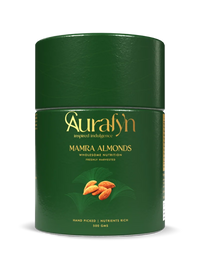
Aurafyn began with this same question. Our search went beyond labels: months of comparison across India’s dry-fruit trade, studying texture, taste, shape, oil and consistency. The almond that met our standard was Iranian Mamra from the Fars region, so we chose it, because it proved itself rather than because it was the easiest story to sell. It is hand-picked and packed unpolished in our paper tubes. See our Iranian Mamra almonds →

For the fuller comparison, including nutrition, farming and when a California almond is honestly the better buy, read Mamra vs California almonds.
Curve, oil, bite, price, label. One failure is a warning; two is a verdict. If a seller’s almonds pass all five, buy with confidence, from us or from anyone else.
Frequently asked questions
How can I tell real Mamra badam at home?
Look, press and taste. Real Mamra kernels are curved and irregular rather than flat and uniform, leave a slight oil mark when pressed hard on paper, and taste sweet with no bitterness. Then check the price: Mamra sold at or near California prices deserves questions.
Mamra badam asli hai ya nakli, kaise pata karein?
Asli Mamra chhota, curved aur oil-rich hota hai. Zor se dabane par kaagaz par halka oil ka nishaan chhodta hai, aur swaad meetha hota hai, kadwa nahi. Flat, ek jaise size ke, chamakdaar badam, aur California jaisa daam: yeh nakli hone ke saaf sanket hain.
Is Gurbandi the same as Mamra?
No. Gurbandi is a genuine Afghan almond, smaller, darker and oil-rich, and good value at its own honest price. It is a problem only when it is blended into Mamra or sold as Mamra at Mamra prices.
Why are Mamra almonds so expensive?
Supply is thin. About 89% of India’s almond imports come from the United States, almost all of them Californian, while Mamra is a low-yield traditional variety grown mainly in Iran on rain-fed orchards and sorted by hand. Branded Iranian Mamra sold at ₹4,300–6,200 a kilo when we checked in September 2026.
Are shiny, polished almonds better?
No. Polishing adds a surface gloss that can hide age and origin. Real Mamra is sold unpolished and matte; its richness is inside the kernel, which is what the press test checks.
Does the water test show if almonds are fake?
Not reliably. Whether an almond sinks or floats depends on its moisture and air pockets, and soaking water darkens naturally from skin tannins. Shape, the press test, taste, price and the label are better guides.
Where does Aurafyn’s Mamra come from?
Iran, from the Fars region. We chose it after months of comparison across India’s dry-fruit trade, because it met our standard for taste, texture and consistency. It is hand-picked and packed unpolished in our paper tubes.
References & Further Reading
- California almond shipments to India forecast to grow: about 89% of India’s almond imports come from CaliforniaCapital Press, 16 September 2026, reporting the USDA Foreign Agricultural Service
- FoSCoS: check any FSSAI licence numberFood Safety and Standards Authority of India
Aurafyn Journal. “How to Identify Real Mamra Almonds: 5 Honest Tests.” Updated 9 Oct 2026. aurafyn.com/blogs/journal/how-to-identify-real-mamra-almonds