Mamra is a rare, rain-fed Iranian almond — smaller, curved and richer in natural oil, prized for raw and soaked eating. California almonds are larger, flatter, milder and far cheaper, ideal for baking and bulk. Branded Iranian Mamra sells at about ₹4,300–6,200/kg (September 2026) against ₹1,000–1,500 for California — if it's cheap, it isn't real Mamra.
"Mamra" is the most misused word in the Indian dry-fruit aisle. It's stamped on bags of ordinary almonds, used to justify a higher price, and rarely questioned. So what actually separates a genuine Iranian Mamra almond from the California almond in most packets — and is the premium worth paying?
This guide breaks the two down side by side: origin, oil content, taste, price, and how to spot the real thing.

Quick Comparison
| Feature | Mamra Almonds | California Almonds |
|---|---|---|
| Origin | Iran (rain-fed orchards) | California, USA (irrigated farms) |
| Oil content | High, rich in oleic acid | Lower |
| Shape | Smaller, rounder, slightly curved | Larger, flatter, uniform |
| Taste | Richer, more intense, naturally sweet | Milder, slightly bland |
| Farming | Traditional rain-fed, no irrigation | Industrial irrigated farming |
| Annual production | ~15,000 tonnes (very limited) | ~1.2 million tonnes (~80% of world supply) |
| Price (India, 2026) | ₹4,300–6,200 / kg (branded, Sep 2026) | ₹1,000–1,500 / kg (branded, Sep 2026) |
| Best for | Raw eating, soaked almonds, Unani tradition | Cooking, baking, almond milk, snacking |
| Shelf life | Shorter (higher oil oxidises faster) | Longer |
What Are Mamra Almonds?
Mamra almonds are grown almost exclusively in Iran — primarily in the provinces of Fars, Isfahan, and Chaharmahal-Bakhtiari. Unlike California almonds, which are grown on irrigated industrial farms, Mamra almonds grow on traditional rain-fed orchards in semi-arid mountain regions.
This natural, low-intervention farming is precisely what makes Mamra almonds special. Without irrigation, the trees produce fewer almonds per acre, but each nut develops a higher concentration of natural oils. That oil content is what gives Mamra almonds their distinctive rich, buttery taste.
Why Are Mamra Almonds More Expensive?
- Scarcity: Iran produces roughly 15,000 tonnes of Mamra almonds a year. California alone produces over 1.2 million tonnes annually — about 80% of the world's supply.[2][3] Mamra represents only a tiny fraction of global almond production.
- Low-yield farming: Rain-fed orchards yield far less per acre than irrigated California farms. No shortcuts, no mass production.
- Import logistics: Importing from Iran to India involves international shipping, customs duties, and careful storage. Each step adds cost.
Nutrition Comparison
The key nutritional point of difference is oil quality — Mamra almonds are particularly rich in oleic acid, the same heart-healthy monounsaturated fat (MUFA) found in olive oil, which research links to cardiovascular benefit.[1][4] This is also why soaked Mamra almonds are valued in Unani and Ayurvedic traditions, where they're eaten for brain health and memory.
A real Mamra is small, curved and rich with oil — if it's large, flat and faultless, it was never Mamra.
Taste & Texture
- Mamra almonds have a rich, almost buttery flavour eaten raw. The high oil content gives a satisfying crunch and a natural sweetness that lingers. Soaked overnight, they turn creamy and soft.
- California almonds are milder. They work better in cooking and baking precisely because their flavour doesn't dominate a dish.
If you eat almonds raw or soaked — the traditional Indian "badam" for breakfast — Mamra is noticeably superior. If you're making almond flour, almond milk, or baking, California almonds are perfectly fine and more cost-effective.
How to Identify Real Mamra Almonds

- Shape: Mamra almonds are smaller, rounder, and slightly curved. If they look large, flat and uniform, they're almost certainly California.
- Oil test: press a kernel firmly with your thumb — genuine Mamra feels oily and leaves a slight residue. California almonds feel drier.
- Taste: a single raw Mamra almond is noticeably richer and sweeter than a California one.
- Price: if "Mamra" is selling at or near California prices (about ₹1,000–1,500/kg), it's almost certainly rebranded California. Branded Iranian Mamra sold at ₹4,300–6,200/kg when we checked in September 2026; Kashmiri Mamra, a different variety, from about ₹3,200 (see our five-brand comparison).
- Source transparency: a trustworthy seller names the sourcing region and holds an FSSAI licence. Aurafyn's FSSAI licence number is 22725925002232.[5]
For all five checks, in the order a trader runs them, see How to Identify Real Mamra Almonds.
So — Which Should You Buy?
Choose Mamra if…
- You eat almonds raw or soaked daily (the traditional "badam" routine)
- You value taste and oil-richness over price
- You follow Unani or Ayurvedic dietary practices
- You're buying for a thoughtful gift
Choose California if…
- You mainly use almonds for cooking, baking or almond milk
- Budget is your primary concern
- You need large quantities for a kitchen or business
- You prefer a milder, less oily flavour
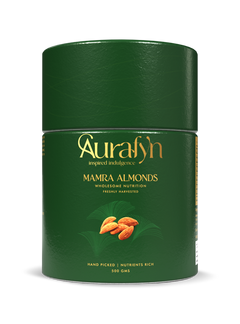
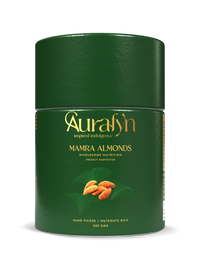
Aurafyn Mamra Almonds from Iran
Rain-fed, hand-picked and rich in natural oil — the traditional soaked-badam almond, grown in Iran and packed in Srinagar.
How to Store Almonds
- Room temperature: airtight container, cool dark place — good for 2–3 months.
- Refrigerator: extends shelf life to 6–9 months. Recommended for Mamra because of its higher oil content.
- Freezer: up to 12 months. Thaw at room temperature before eating.
- Avoid: direct sunlight, humidity, and storing near strong-smelling foods.
For Mamra specifically: buy in smaller quantities (200–500 g) and finish within 2–3 months for the best flavour. Refrigerate if you live in a warm climate.
The Bottom Line
California almonds are a perfectly good, affordable everyday nut. Mamra almonds are a premium one — rarer, richer in taste, and higher in natural oils. The price reflects genuine scarcity and traditional farming, not marketing.
If you're buying almonds for the daily soaked-badam ritual, the upgrade to Mamra is worth it — you'll taste the difference with the first bite. Aurafyn's Mamra almonds are grown in Iran, packed in Srinagar and delivered free across India, FSSAI licensed (No. 22725925002232).[5]
Frequently asked questions
What is the difference between Mamra and California almonds?
Mamra is a rain-fed Iranian almond, smaller and rounder with a slight curve, high in natural oil and rich, almost buttery raw. California almonds are grown on irrigated industrial farms and are larger, flatter, more uniform and milder. Mamra suits raw and soaked eating; California suits baking, almond milk and bulk cooking.
Why are Mamra almonds so expensive?
Three things compound. Iran produces roughly 15,000 tonnes of Mamra a year against California's 1.2 million tonnes, about 80% of world supply. Rain-fed orchards yield far less per acre than irrigated farms. And importing from Iran adds shipping, customs and careful storage at every step.
What should genuine Mamra almonds cost in India?
When we checked branded sellers in September 2026, genuine Iranian Mamra cost about ₹4,300 to 6,200 per kilo (Aurafyn ₹4,300, Happilo ₹4,860, Nutraj ₹6,210), against ₹1,000 to 1,500 for California. Kashmiri Mamra, a different variety, starts around ₹3,200. Anything labelled Mamra at or near California prices is almost certainly rebranded California.
How can I tell if Mamra almonds are real?
Start with shape. Real Mamra is small, plump and curved with deep ridges, never large, flat and faultless. Press a kernel firmly with your thumb: genuine Mamra feels oily and leaves a slight residue, while California feels dry. Raw, a single Mamra tastes noticeably richer and sweeter. Then check the price, and whether the seller names a sourcing region and holds an FSSAI licence.
Where are Mamra almonds grown?
Almost entirely in Iran, mainly in the provinces of Fars, Isfahan and Chaharmahal-Bakhtiari, on traditional rain-fed orchards in semi-arid mountain country. Without irrigation the trees carry fewer almonds per acre, and each nut develops a higher concentration of natural oil.
Are Mamra almonds healthier than California almonds?
The meaningful difference is oil quality rather than calorie count. Mamra is particularly rich in oleic acid, the same monounsaturated fat found in olive oil, which research links to cardiovascular benefit. That oil content is also why soaked Mamra is the almond traditionally used in Unani and Ayurvedic practice. This is general information, not medical advice.
Which almond is better for soaking?
Mamra. Soaked overnight it turns creamy and soft, and the oil gives a natural sweetness that lingers. This is the traditional Indian badam eaten at breakfast. California almonds soak perfectly well but stay milder.
Do Mamra almonds keep as long as California almonds?
No. The higher oil content that gives Mamra its flavour also oxidises faster, so the shelf life is shorter. Store almonds airtight, away from heat and light, and buy Mamra in quantities you will actually finish.
This guide cites peer-reviewed research on monounsaturated fats and traditional Unani and Ayurvedic practice. It is general nutrition information, not personal medical advice — please consult your doctor for your individual needs.
References & Further Reading
- Nuts, almonds — nutrient composition (fat & oleic acid)USDA FoodData Central
- California almond production & global supplyAlmond Board of California
- Global almond production statisticsFAOSTAT — Food and Agriculture Organization
- Ros E. Health benefits of nut consumption (oleic acid & cardiovascular health)Nutrients, 2010; 2(7):652–682
- Food Safety and Standards Act, 2006Food Safety and Standards Authority of India (FSSAI)
Aurafyn Journal. “Mamra Almonds vs California Almonds: What's the Difference?.” Updated 18 Oct 2026. aurafyn.com/blogs/journal/mamra-almonds-vs-california-almonds-whats-the-difference