In the traditional orchards described here, a walnut tree is grown from seed and needs 15 to 20 years before it gives a real crop. The season runs from around 20 August to 20 September, later at altitude. There is no machine in this account — a man climbs the tree and beats the branches with a willow pole, and everything after that is done by hand, down to a week to ten days of drying at two to three hours of sun a day.
Reported from Kashmir by Gowher Rah of Holidays to India, Srinagar, the partner who packs Aurafyn's walnuts. He is Kashmiri and has spent years around these orchards — buying, sorting and packing the crop, and talking to the men who climb the trees. He does not farm them himself. What follows is the practice he knows from season after season in the valley; the footage is from September 2026. Practice and timing vary between orchards, and Kashmir also has grafted plantations and mechanised processing lines; neither is part of this supply. The photograph at the top of this page is adapted from his footage; the original film of the climb runs further down.
A tree older than the person picking it
Plant a walnut seedling in Kashmir today and you will wait. A grafted tree can carry sample fruit in its third or fourth year.[10] A seedling will not: the growers Gowher buys from put the first nuts at year seven to ten, and a crop worth taking to market at fifteen to twenty. The species is generally reckoned to bear from four to six years and to give a good crop at fifteen to twenty.[1]
These are seedling trees, grown from a nut in the ground, and in these orchards they are not grafted. The bark is hard; it has another life in Kashmiri households, where strips of it are used to clean the teeth. Grafted walnut is grown in Kashmir too — the ICAR institute at Srinagar raises thousands of grafted plants a year, and SKUAST is promoting medium-sized grafted trees for exactly the uniformity these orchards do not have.[10] That is a different orchard from this one.
Which is why you cannot scale a walnut orchard the way you scale a crop. What Kashmir has is not a plantation. It is an inheritance.
The law treats it as one. Under the Jammu & Kashmir Preservation of Specified Trees Act, 1969, the walnut is a specified tree — named in the statute and protected whether it stands on state land or on your own.[2] You own your tree; you cannot fell it without permission from the department. And “felling” in the Act is drawn wide enough to include topping, lopping and girdling, so even cutting one back hard is regulated.
Read that alongside the twenty years and the shape of the supply becomes clear. You cannot plant your way in, and you cannot cut your way out. The trees standing in Budgam and Baramulla this September are, more or less, the trees there will be.
Where the season starts
The valley does not begin all at once. The season's first pluck belongs to Charar-i-Sharief, in Budgam, some thirty-five kilometres from Srinagar — lower and warmer than Shopian or Kupwara, so its trees come ready while the higher orchards are still weeks away.
Every Kashmiri knows the town for another reason. It holds the shrine of Sheikh Noor-ud-Din Noorani, remembered as Nund Rishi, who lived from about 1377 to 1438 and founded the Rishi order of Kashmiri Sufism.[3] He walked the valley writing verses — shruks — arguing for inner cleansing over outward show, and for reverence toward the land itself. Pilgrims of several faiths still come. That the walnut season opens in his town is a coincidence of geography Kashmiris have never treated as merely one.
The climb
There is no ladder. A man climbs the tree barefoot, the way the work has always been done here. It is not a safe trade: falls during the walnut harvest injure and kill pickers in Kashmir every season.[4] Once up, he works with a laanz — a long, flexible pole of willow — beating along the branches section by section, knocking the ripe fruit loose while leaving next year's growth intact.[4] A good thrasher strips a tree clean and leaves it undamaged; a careless one costs the owner part of next season.
The fruit comes down inside a thick green husk, and that husk is why a walnut survives a Kashmiri autumn at all. Where a hailstorm will bruise and rot an apple crop in an afternoon, the walnut simply takes the hit.

Kheni gooj — the early kernel
Open a walnut early in the season and you find a kernel that is white and soft, wrapped in a pale yellow skin loose enough to peel away with a thumbnail. In Kashmir we call it kheni gooj, and eaten straight from the shell it is milky and sweet, with none of the bitterness of a dried nut.[5]
That skin does not stay loose. As the nut matures it tightens, darkens and fuses to the kernel, and it stops being something you peel off — it becomes part of what you eat. It is also where the walnut keeps its tannins, which is why a mature kernel carries that faint astringency at the back of the bite and an early one does not.[6]
Husking, washing, drying
The husk has to come off within a day or two or it rots against the shell and stains the nut inside. So the sacks are emptied onto tarpaulins and opened by hand, one fruit at a time — slow, stubborn work, usually done by whoever is at home.

Shells come out streaked with husk and sap, and are washed until they run clean. What does not happen in these batches is bleaching. Much of the world's walnut is whitened to a uniform pale shell, and Kashmir has mechanised bleaching lines of its own, developed at SKUAST. These shells are untreated, and they dry mottled, with the grain showing. That unevenness is what an honest shell looks like.

Drying is the step that decides everything afterwards, and in the yards Gowher has watched season after season it is rationed rather than rushed: two to three hours of sun a day, for a week to ten days. The chemistry behind that caution is well established. Walnut oil oxidises readily, and the volatiles oxidation produces are the same compounds tasters register as rancid and bitter; moisture left in the kernel accelerates it.[7] Cut that short and phaphund — mould — takes hold from the inside, where nobody can see it until it is too late. A walnut carries a great deal of oil; it does not go stale, it goes rancid.

Dry it properly and it keeps for months. Hurry it, and you have ruined a year's work in an afternoon.
Why one tree sorts faster than another
Grading starts long before anyone picks up a nut. A tree standing in full, even sun ripens its crop uniformly, and the kernels come out a consistent pale colour — a batch that barely needs sorting. A tree shaded on one side gives a mixed grade from the same harvest: some kernels light, some darker, all of it needing to be separated by hand afterwards. The position of the tree sets how much work the kernel makes later.
The season, stage by stage
| Stage | Who or what does it | What it decides |
|---|---|---|
| Growing | 15–20 years, from seed | Whether there is a crop at all |
| Timing | The tree, not the calendar | Kernel fill and colour |
| Plucking | A climber with a laanz | This year's crop, next year's growth |
| Husking | By hand, within 1–2 days | Staining and rot |
| Washing | Running water, no bleach | Honest shell colour |
| Drying | 2–3 hrs sun a day, 7–10 days | Shelf life and rancidity |
| Sorting | Eye and hand | Grade, halves vs pieces |
| Felling | Needs state permission | Protection of existing trees |
Every row is a place where a corner can be cut without it showing in a photograph. That is the argument for knowing when and where a walnut was picked.
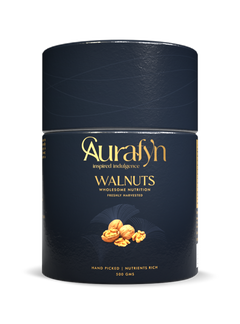
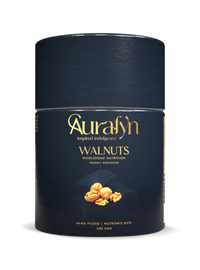
Premium Kashmir Walnuts
Current season, unbleached, sealed in an airtight paper tube rather than a pouch — because a walnut's enemy after all this work is simply air.
Frequently asked questions
When are walnuts harvested in Kashmir?
Broadly from around 20 August to 20 September, extending into mid-October at higher altitude. The season opens first around Charar-i-Sharief in Budgam, which sits lower and warmer than the other growing districts.
Are Kashmir walnut trees grafted?
Not in the traditional orchards this article describes. Those are grown from seed, which is why a tree takes 15 to 20 years to give a real crop, and the bark is hard enough that strips of it are traditionally used in Kashmir to clean the teeth. Grafted walnut is grown in Kashmir as well: ICAR's institute at Srinagar supplies thousands of grafted plants a year, and they can carry sample fruit by their third or fourth year.
What is kheni gooj?
The Kashmiri name for the walnut kernel early in the season, when it is still white and soft and its pale yellow skin peels off with a thumbnail. Eaten fresh it is milky and sweet. As the nut matures that skin tightens, darkens and fuses to the kernel, becoming part of what you eat — and carrying the tannins that give a dried walnut its slight bitterness.
How long are Kashmir walnuts sun-dried?
Growers in the valley dry them for a week to ten days, giving the nuts two to three hours of direct sun a day rather than leaving them out from dawn to dusk. That is the practice Gowher has watched season after season in Kashmir, not a universal schedule. The reasoning is that walnut oil oxidises readily and the volatiles oxidation produces are the ones tasters register as rancid and bitter,[7] while too little drying lets mould take hold inside the shell.
Can you cut down a walnut tree in Kashmir?
Not freely. The Jammu & Kashmir Preservation of Specified Trees Act, 1969 names the walnut as a specified tree and protects it on private land as well as state land, so felling one requires permission from the department. The Act defines felling broadly enough to cover topping, lopping and girdling.
Are Kashmir walnuts machine-harvested?
Not in the orchards described here. American walnuts are harvested by mechanical trunk shakers; in this account a climber beats the branches with a willow pole called a laanz, and gathering, husking, washing, drying and sorting are all done by hand. Mechanised processing does exist in Kashmir — SKUAST has developed dehulling, washing, bleaching and drying lines — but it is not part of this supply.
Why are Kashmiri walnut shells uneven in colour?
Because these have not been bleached. Uniformly pale shells usually result from a whitening wash, which is standard in much of the trade and is done mechanically in Kashmir too. Untreated shells dry mottled tan to grey-brown, with visible grain.
Why do some Kashmir walnuts vary in kernel colour?
In Gowher's experience it is largely down to where the tree stands: a tree in full, even sun ripens uniformly and gives consistent pale kernels, while a partly shaded tree gives a mixed grade from the same harvest, which then has to be separated by hand. That is what he has learned from years of sorting these batches at the packing house, not a published finding.
References & Further Reading
- Juglans regia — bearing age and mature sizeNC State Extension Gardener Plant Toolbox
- Jammu and Kashmir Preservation of Specified Trees Act, 1969 (Act No. V of 1969)India Code — Government of India
- Charar-e-Sharief shrine and Sheikh Noor-ud-Din NooraniHistorical record
- Walnut harvesting method in Kashmir — ground reportIndia Development Review
- Fresh green walnuts — the white, underdeveloped kernelSpecialty Produce
- Pellicle tannins and walnut flavourCalifornia Walnut Commission
- Oxidative stability of walnut kernel and oil — rancidity, bitterness and moisturePeer-reviewed literature
- Walnut Industry in Jammu and Kashmir: A Geographical AnalysisTaufique & Khursheed, Research Journal of Humanities & Social Sciences, vol. 9 no. 4, 2018
- Kashmir's walnut harvest in full swingGreater Kashmir
- Grafted walnut planting material in KashmirICAR — Central Institute of Temperate Horticulture, Srinagar
Local knowledge, field observations, footage and Kashmiri terms: Gowher Rah, Holidays to India, Srinagar, September 2026.
Aurafyn Journal. “How Kashmir Walnuts Are Harvested: Inside a 20-Year Tree's Season.” Updated 20 Sep 2026. aurafyn.com/blogs/journal/how-kashmir-walnuts-are-harvested